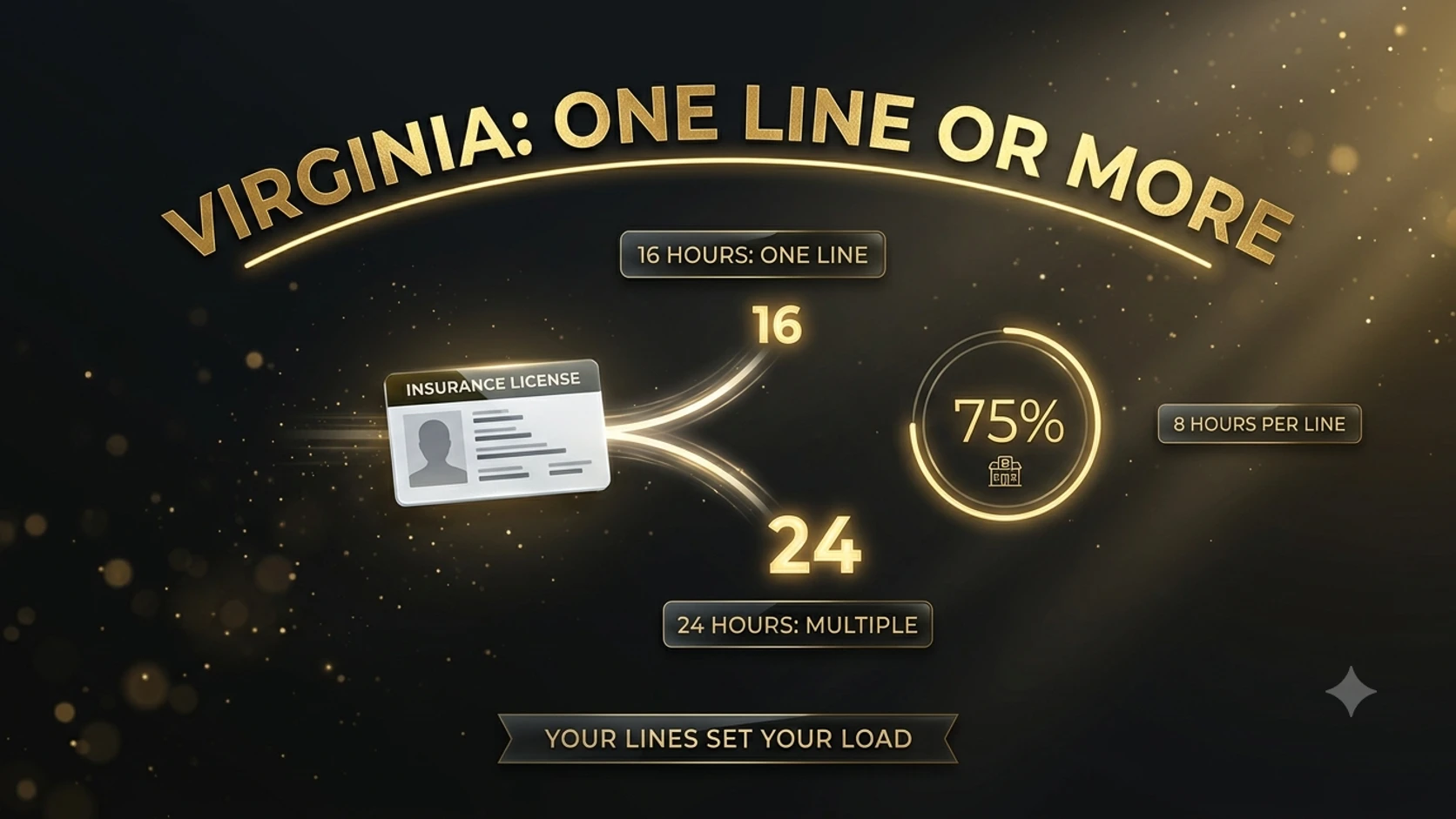
The total hour count depends on how many lines you hold
Virginia takes a middle-ground approach between states that apply one flat hour total regardless of lines held (like North Carolina) and states that double the requirement per major line (like New York): a Virginia producer holding a single line of authority owes 16 hours of CE every two years, while a producer holding two or more lines owes 24 hours — a meaningful step up, but not a full doubling.
Both totals include the same core 3-hour ethics requirement, which may include insurance law and regulations specific to Virginia. A producer moving from a single-line license to adding a second line mid-career should recalculate their next renewal's hour target rather than assuming their prior 16-hour habit still applies.
A cap on company- and agency-provided coursework
Virginia limits how much of a producer's required CE can come from courses provided or given by insurance agencies or insurance companies: no more than 75% of the required credits may come from that source. This is meant to ensure a meaningful portion of CE comes from independent, third-party educational content rather than being entirely composed of a producer's own employer's internal training.
A producer relying heavily on their agency's in-house training program for CE credit should track what share of their total hours that actually represents, since exceeding the 75% cap from that single source category could leave the remaining requirement technically unmet even if the total hour count looks sufficient on paper.
Multi-line producers need 8 hours specific to each license type
For producers holding multiple lines of authority (which triggers the 24-hour total described above), Virginia requires at least 8 credits to be specific to each license type held, rather than allowing the full 24 hours to be satisfied entirely through general or single-line coursework. This ensures a multi-licensed producer maintains meaningfully current knowledge across each line they're actually authorized to sell, not just their primary specialty.
A producer holding both life/health and property/casualty authority, for example, needs to specifically allocate at least 8 of their 24 hours to each line rather than clustering all their CE in whichever line they personally focus on day to day.
Renewal timing and consequences of non-compliance
Virginia's renewal cycle is based on the licensee's date of birth (month and year), and all CE hours must be completed and reported prior to the renewal date to avoid a lapse — failure to complete CE causes the license to be administratively terminated rather than simply flagged for follow-up.
Worked example: a multi-line producer allocating hours correctly
A Virginia producer holds both life/health and property & casualty authority, putting her in the 24-hour tier. She allocates at least 8 hours specifically to life/health topics and at least 8 hours specifically to property & casualty topics, leaving roughly 5 hours of flexible general or additional-topic credit plus her 3-hour ethics course to complete the 24-hour total.
She also tracks how many of her hours come from her own agency's internal training sessions, making sure that source stays under the 75% cap by supplementing with independent third-party CE providers for a meaningful share of her total.
Why the 75% company-course cap exists and how producers stay under it
Virginia's 75% cap on company- or agency-sponsored coursework reflects a regulatory concern that CE composed entirely of an employer's internal training could, in principle, drift toward reinforcing a single company's specific sales practices and products rather than exposing a producer to the broader range of professional standards and product knowledge that independent third-party CE providers typically cover.
In practice, most producers whose primary CE source is company training don't come close to breaching the 75% cap, since even agencies with active internal training programs rarely offer more than a handful of CE-eligible hours per term — the cap becomes practically relevant mainly for captive agents at larger carriers with extensive in-house training departments that could plausibly cover a producer's entire requirement internally if the cap didn't exist.
A Virginia producer uncertain whether they're approaching the cap should ask their compliance or training department directly whether the courses they've completed are classified as 'agency- or company-provided' under the state's specific rule, since this classification isn't always obvious from a course's title or general marketing — a course technically delivered by a third-party vendor but exclusively arranged and paid for by the producer's agency may still count toward the cap depending on how Virginia's Bureau of Insurance defines the sponsorship relationship.
How Virginia's line-specific minimums interact with the 75% company-course cap
A multi-licensed Virginia producer needs to satisfy both constraints simultaneously — the 8-hours-per-line minimum and the 75% cap on company-sponsored coursework — which means a producer relying heavily on employer training for one specific line should verify that reliance doesn't push their overall company-sourced total past 75% even if each individual line's 8-hour minimum is comfortably met through a mix of sources.
The bottom line
Virginia's line-dependent hour total, its 75% company-course cap, and its 8-hours-per-line minimum for multi-licensed producers combine into a more structured requirement than the simple 16-or-24 headline figure suggests — multi-licensed Virginia producers in particular should map out their specific per-line allocation well before their renewal deadline.
Virginia's layered structure — line-dependent totals, a company-course cap, and per-line minimums for multi-licensed producers — rewards the kind of early-term planning that maps every constraint out before selecting a single course, rather than the more common habit of accumulating hours loosely and hoping the categories sort themselves out by the deadline.
Primary and official sources used for this guide
Virginia State Corporation Commission — Bureau of Insurance Continuing EducationPrimary/official source for Virginia's line-dependent CE hour totals and the company-course cap.↗Source pages can change. Check the current text and effective date before relying on a threshold, waiting period, or required form.