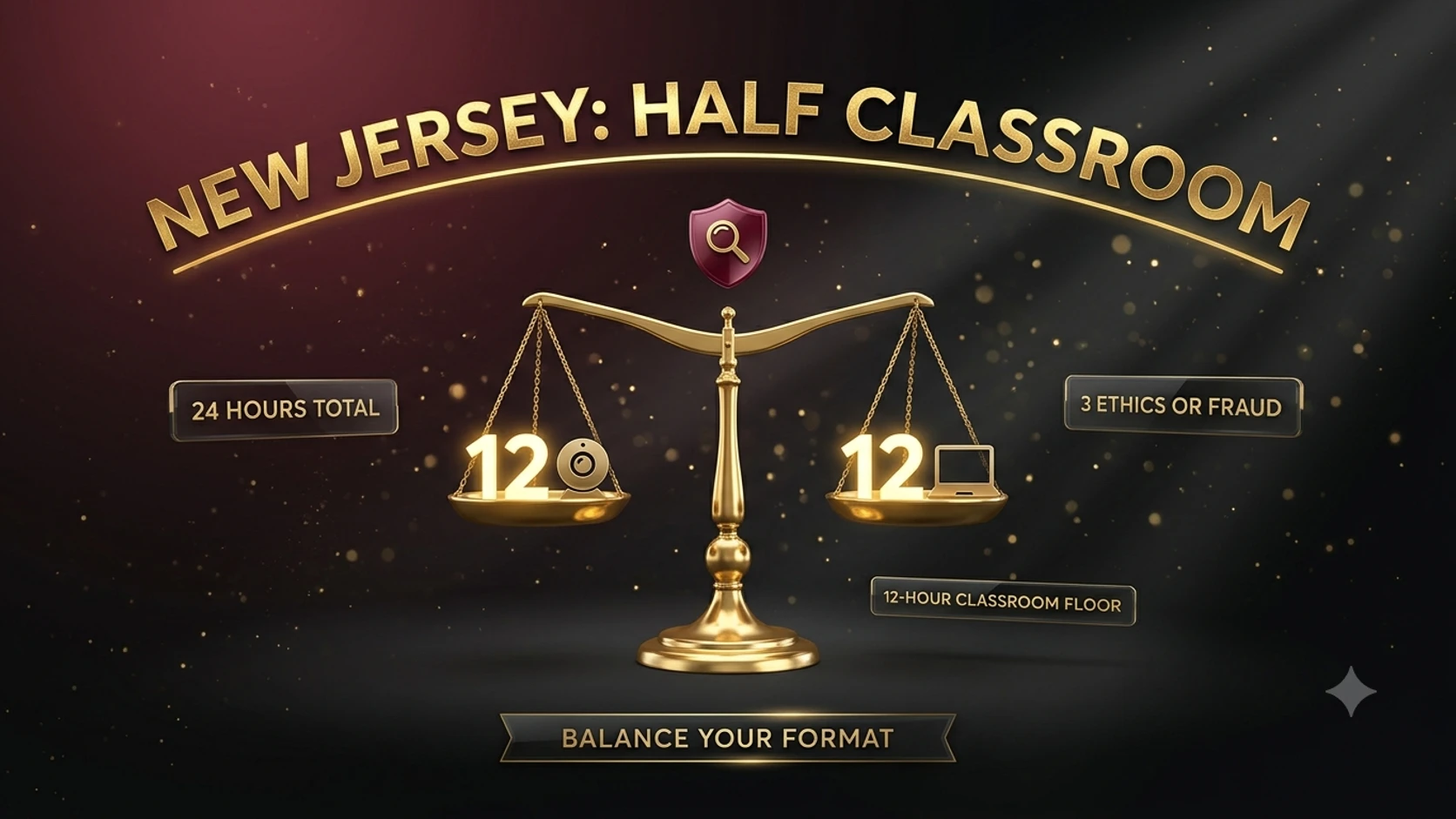
24 hours, with half required to be classroom-equivalent
New Jersey requires licensed producers to complete 24 hours of continuing education every two-year term, including 3 hours of ethics — the familiar baseline structure. What sets New Jersey apart is a delivery-format requirement affecting half the total: at least 12 of the 24 hours must be completed through classroom instruction or classroom-equivalent delivery, defined as live instruction with real-time interaction between instructor and students.
This is a stricter classroom-equivalent minimum than Texas's roughly similar rule (which also requires half classroom-equivalent, but for a state many producers compare New Jersey against directly). A producer planning to complete their entire New Jersey requirement through purely self-paced, on-demand video courses will fall short regardless of how many total hours they accumulate that way.
The ethics hours have a fraud-training substitution option
New Jersey's 3-hour ethics requirement is mandatory, but the state allows one specific substitution: one credit hour of professional ethics can be replaced with one credit hour focused on insurance fraud instead. This gives producers slightly more flexibility in course selection than a flat, single-topic ethics requirement, while still requiring the core 3-hour commitment.
This substitution option is easy to miss if a producer assumes 'ethics' in New Jersey means exactly the same single-topic course structure used in a neighboring state. Check the specific course catalog descriptions for New Jersey rather than assuming any generic ethics course automatically satisfies the requirement in the same way it might elsewhere.
Ethics hours don't carry over — general hours partially do
Resident individual producers who complete more than 24 credit hours during a licensing term may carry over up to 12 excess credits to the next renewal term. Credit hours earned specifically in ethics, however, may not be carried over — meaning the fresh 3-hour ethics (or ethics/fraud-substituted) requirement applies every single term regardless of any excess accumulated previously.
This carryover structure is consistent with the general pattern seen across most states: general CE hours can bank forward to ease a future term, but the ethics-designated portion resets every cycle without exception.
Renewal timing
The New Jersey license renewal date is the last day of the licensee's birth month, on a biennial (two-year) cycle — the standard birth-month pattern found in most states covered on this site.
Worked example: hitting the 12-hour classroom-equivalent floor
A producer plans his New Jersey CE around a live 3-hour ethics webinar (counting toward both his classroom-equivalent minimum and his ethics requirement simultaneously) plus 9 additional hours of live or interactive webinar-based product training, bringing his classroom-equivalent total to exactly 12 — the required floor.
He completes his remaining 12 hours through self-paced online courses of his choosing, confident that his total 24 hours satisfies both the overall hour count and the classroom-equivalent-format minimum, since he tracked the two separate requirements as he scheduled his courses rather than assuming any 24 hours of CE, regardless of format, would automatically qualify.
Finding genuinely classroom-equivalent courses in New Jersey
New Jersey's course-approval system requires providers to specifically designate whether a given course qualifies as classroom-equivalent, and this designation is searchable through the New Jersey Department of Banking and Insurance's approved course listings. A producer building their plan around the 12-hour classroom-equivalent floor should filter directly by this designation rather than guessing based on a course's marketing description, since terms like 'interactive' or 'live-assisted' are sometimes used loosely by providers in ways that don't necessarily meet the state's specific real-time-interaction standard.
New Jersey's insurance-fraud substitution option for one of the three ethics hours reflects the state's particular regulatory emphasis on fraud prevention — New Jersey has historically maintained an active Office of the Insurance Fraud Prosecutor, and channeling some producer CE toward fraud awareness aligns with that broader state priority. Producers who take advantage of this substitution should confirm the specific course is approved under New Jersey's fraud-substitution category, not simply any general insurance-fraud-themed course.
A New Jersey producer's most efficient path to compliance is often a single live 3-hour ethics (or 2-hour ethics plus 1-hour fraud) webinar that simultaneously satisfies both the ethics requirement and a meaningful chunk of the 12-hour classroom-equivalent floor, followed by additional live or interactive sessions to complete the remaining classroom-equivalent hours before filling out the balance with self-paced coursework.
Why some producers over-satisfy the classroom-equivalent floor without meaning to
Many producers naturally gravitate toward live webinars for ethics and product-update content simply because they prefer the interactive format, which sometimes means a New Jersey producer clears the 12-hour classroom-equivalent floor well before consciously planning around it. Confirming this with the state's course database, rather than assuming, is still worthwhile — a producer who prefers live formats for some courses but fills the remainder entirely with self-paced content could still fall short if their live-format hours don't add up to the required 12 specifically.
The bottom line
New Jersey's 12-hour classroom-equivalent floor and its ethics/fraud substitution option both reward producers who plan their course format deliberately rather than defaulting entirely to self-paced content, which alone cannot satisfy the state's full 24-hour requirement no matter how many hours it adds up to.
New Jersey's fraud-substitution option is a small but genuinely useful piece of flexibility for producers who find fraud-prevention topics more directly relevant to their day-to-day work than a purely general ethics course, and it's worth exploring specifically rather than defaulting automatically to the standard 3-hour ethics track.
New Jersey producers should also double check that any course counted toward the classroom-equivalent floor wasn't quietly reclassified by its provider between terms, since a provider occasionally shifts a course's delivery format (say, from live webinar to on-demand recording) without necessarily flagging that change prominently to returning students.
Primary and official sources used for this guide
New Jersey Department of Banking and Insurance — Producer Continuing EducationPrimary/official source for New Jersey's CE hours, classroom-equivalent minimum, and ethics substitution rule.↗Source pages can change. Check the current text and effective date before relying on a threshold, waiting period, or required form.