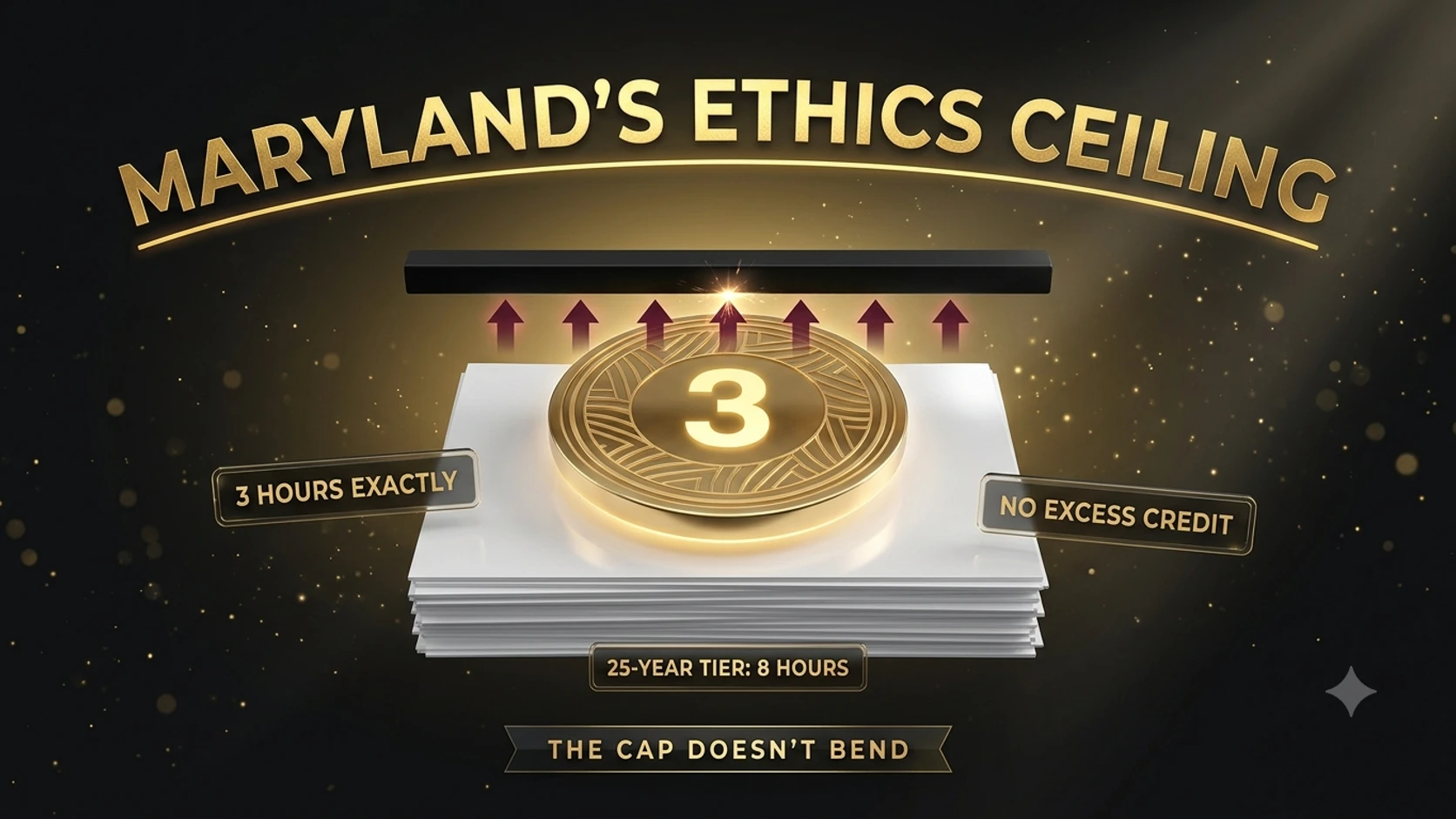
24 hours, with a hard cap on how much ethics counts
Maryland requires producers to complete 24 hours of continuing education every two-year license term, including 3 hours specifically in ethics. Maryland adds an unusual constraint most states don't have: no more than 3 hours of ethics coursework can be applied toward the requirement at all — ethics credits earned in excess of that 3-hour minimum will not be applied to the overall continuing education requirement as general credit either.
This is stricter than the more common pattern (where excess ethics simply downgrades to general credit) — in Maryland, taking a 6-hour ethics course instead of a 3-hour one doesn't give a producer any extra credit toward their remaining 21 general hours. The additional 3 hours are effectively wasted for CE-credit purposes, even though the knowledge itself obviously isn't wasted.
Multi-line producers need 6 hours specifically per line
For producers holding multiple lines of authority — specifically called out for Life/Health and Property/Casualty combinations — Maryland requires students to take approved courses in the line of authority in which they are licensed, with multiline producers needing to complete 6 hours in each line rather than treating the full 24-hour total as fully interchangeable across lines.
This line-specific allocation requirement is similar in spirit to Virginia's 8-hours-per-line rule for multi-licensed producers, though Maryland's specific figure (6 hours) and its explicit naming of the Life/Health and Property/Casualty combination make it worth checking directly rather than assuming the same number applies as in a neighboring state.
No carryover, and a strict course-repeat spacing rule
Maryland does not allow any carryover of excess hours between renewal terms — every two-year cycle starts fresh, similar to Washington's structure. Courses may not be taken more than once in a single reporting period, and if a producer does take the same course during two consecutive renewal periods (which is allowed, unlike some states), there must be at least 6 months between the two completion dates.
Producers must also complete their CE credits at least 15 days prior to the license expiration date, a shorter buffer than Michigan's 45 days but still a real requirement to build into renewal planning.
Given Maryland's stricter category boundaries, producers should plan their course selection early enough in the term that the 15-day pre-deadline buffer doesn't become a source of pressure to accept whatever course happens to be available.
The 25-year experience tier: an 8-hour total
Producers who have been licensed continuously for 25 years or more need to complete only 8 hours of CE every license term — a substantial reduction from the standard 24-hour requirement — though the same 3 hours of that reduced total must still be in ethics, meaning the 25-year tier leaves only 5 hours of general/line-specific coursework rather than the standard 21.
This 25-year milestone is later than Georgia's 20-year mark and considerably later than the 6-year mark used in a few other states, underscoring how much the specific experience-tier threshold varies state by state even where the general concept (experienced producers owe less) is shared.
Worked example: a dual-licensed producer under the standard tier
A Maryland producer holding both Life/Health and Property/Casualty authority, licensed for 12 years (well under the 25-year reduced tier), plans her 24-hour requirement as: exactly 3 hours of ethics (no more, since additional ethics hours wouldn't count toward her general total anyway), 6 hours specific to Life/Health, 6 hours specific to Property/Casualty, and the remaining 9 hours from any approved coursework in either line.
She schedules everything to finish at least 15 days before her birth-month expiration date, and avoids repeating any course she took in her prior renewal period unless at least 6 months has passed since that prior completion.
The bottom line
Maryland's strict category boundaries — where excess ethics hours don't convert to general credit, and multi-line producers need specific per-line allocations — make Maryland's CE requirement more structured than its 24-hour headline figure suggests, rewarding producers who plan deliberately rather than accumulating hours loosely across categories.
Primary and official sources used for this guide
Maryland Insurance Administration — Continuing EducationPrimary/official source for Maryland's line-specific hours, no-carryover rule, and 25-year experience tier.↗Source pages can change. Check the current text and effective date before relying on a threshold, waiting period, or required form.