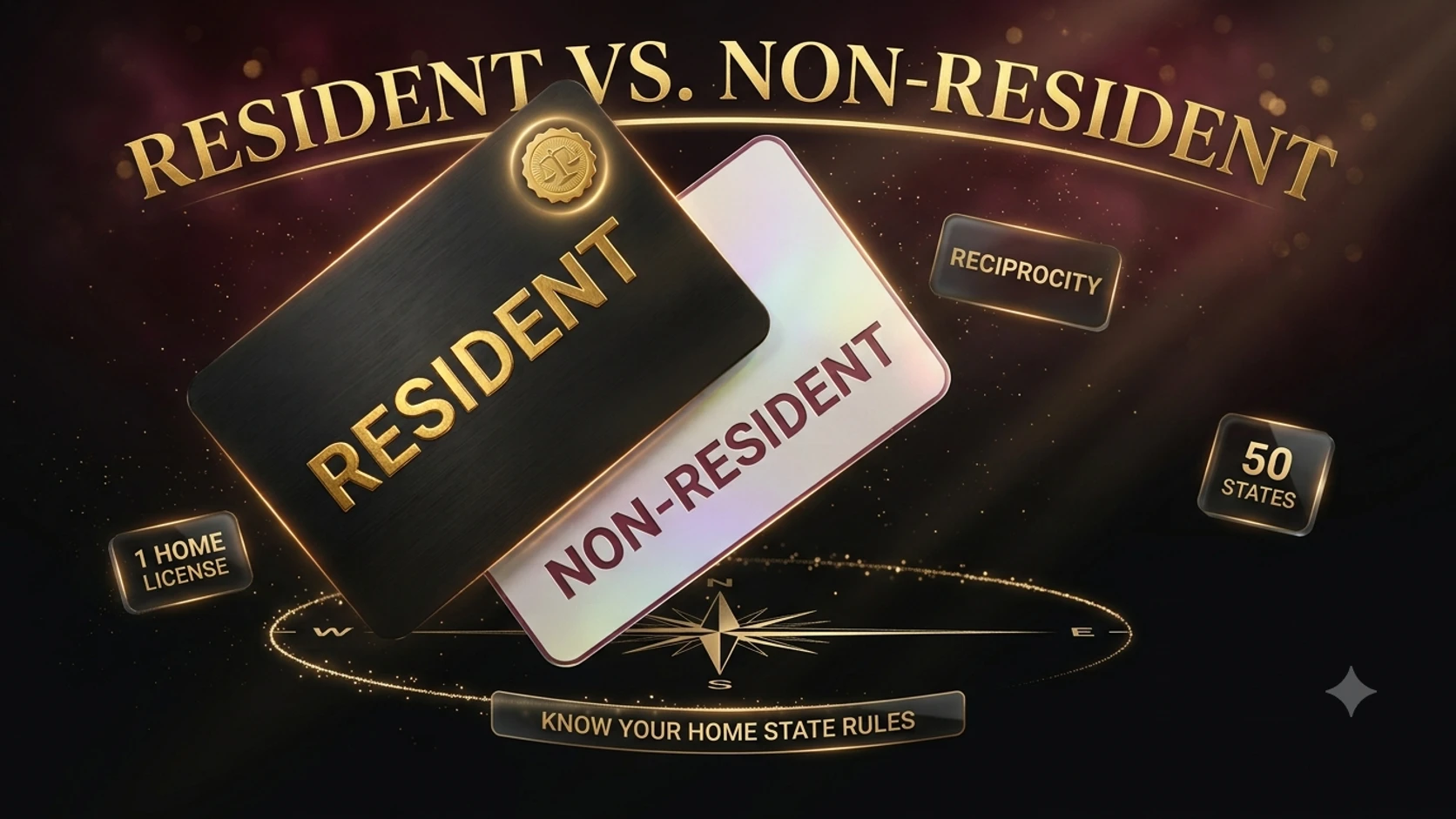
Resident state is where your CE obligation actually starts
A producer's resident state is the state where they maintain their primary residence or principal place of business, and it is that state's insurance department that sets the baseline continuing-education requirement most producers have to satisfy to keep their license active.
Everything else — non-resident licenses in other states, reciprocity agreements, and any additional state-specific coursework — gets layered on top of that resident requirement, not substituted for it. A producer who only tracks their busiest sales state's CE rule while ignoring their actual resident-state requirement can end up non-compliant at home even while staying current everywhere else.
Reciprocity does not mean 'no non-resident CE at all'
Most states participate in the NAIC's producer licensing reciprocity framework, which is why a producer can often hold licenses in a dozen states without repeating the pre-licensing exam in each one. Continuing education reciprocity works differently: many non-resident states will accept a producer's resident-state CE completion as satisfying the non-resident requirement, but that acceptance is not universal and is not automatic.
A handful of states still require CE to be reported to them directly, or require a specific state-law course (an ethics module referencing that state's statute, for example) regardless of what the resident state accepted. Treat every non-resident license as its own line item to check, not as an assumption that resident-state compliance covers it.
How the two obligations get tracked separately
Most states now report CE completions through Sircon or the NIPR PDB (Producer Database), which is how a resident-state completion becomes visible to a non-resident state that participates in the same reporting system. That electronic reporting is what makes reciprocity workable in practice — a course provider reports the completion once, and participating states pull from the same record.
A producer should still periodically pull their own CE transcript from Sircon or NIPR rather than assuming every state's system reflects the same status. Reporting delays, a provider that failed to submit a completion, or a state that requires a separate manual submission can all create a gap between what a producer believes is true and what the state's own record shows.
A simple audit for a multi-state producer
List every state where you hold an active license, resident and non-resident. Next to each, write down: total CE hours required this cycle, whether that state accepts resident-state reciprocity or requires its own reporting, whether it has a state-specific mandatory course, and the renewal date.
Cross-check that list against your actual Sircon/NIPR transcript at least once per renewal cycle, not just once when you first got licensed. States periodically change their hour requirements or their reciprocity stance, and a list built two renewal cycles ago can quietly go stale.
- Resident state name and total CE hours required
- Each non-resident state: reciprocity accepted? Y/N
- Any state-specific mandatory course (ethics, flood, annuity suitability)
- Renewal date per state (birth-month, biennial, or fixed cycle)
- Date you last pulled your Sircon/NIPR transcript to verify
Why this distinction trips up producers who work across state lines
The resident/non-resident split matters most for producers who hold appointments in more than one state — a common situation for agents working in metro areas that straddle a state border, or for captive agents whose company licenses them broadly. A producer's home state is always resident, and every other state where they hold an active license is non-resident, regardless of how much or how little business they actually write there.
The practical risk is treating every license the same way operationally. A producer might diligently track their resident-state CE deadline because it's the one tied to their primary agency's compliance calendar, while quietly letting a non-resident license lapse because no one at the home office is watching that state's specific renewal date. Non-resident CE compliance is usually the licensee's own responsibility to track, not something a home-state compliance department automatically monitors on their behalf.
A reasonable system for a multi-state producer is a single spreadsheet or calendar listing every state license held, its specific renewal date, its specific hour requirement, and whether that state's reciprocity rule means home-state CE alone satisfies it or whether state-specific coursework is still required. Reviewing that list quarterly catches gaps well before any single deadline becomes urgent.
A short monthly review — even five minutes scanning that list against each state's published renewal date — catches an approaching deadline with enough runway to act, and agencies employing multi-state producers can reduce the risk further with a shared compliance calendar rather than leaving each producer to track their own non-resident obligations alone.
The bottom line
Resident versus non-resident status doesn't change how seriously a state expects its CE rules to be followed — it only changes which state's specific hour count, deadline, and reciprocity terms apply to a given license. Treating every license on a producer's roster with equal diligence, resident or not, is the single most reliable way to avoid an avoidable lapse.
Primary and official sources used for this guide
NIPR — Understand Insurance Continuing Education RequirementsPrimary/official source on resident vs. non-resident CE structure.↗NIPR — Stay on Track with Continuing EducationPrimary/official source on CE tracking and reporting through Sircon/NIPR.↗Source pages can change. Check the current text and effective date before relying on a threshold, waiting period, or required form.