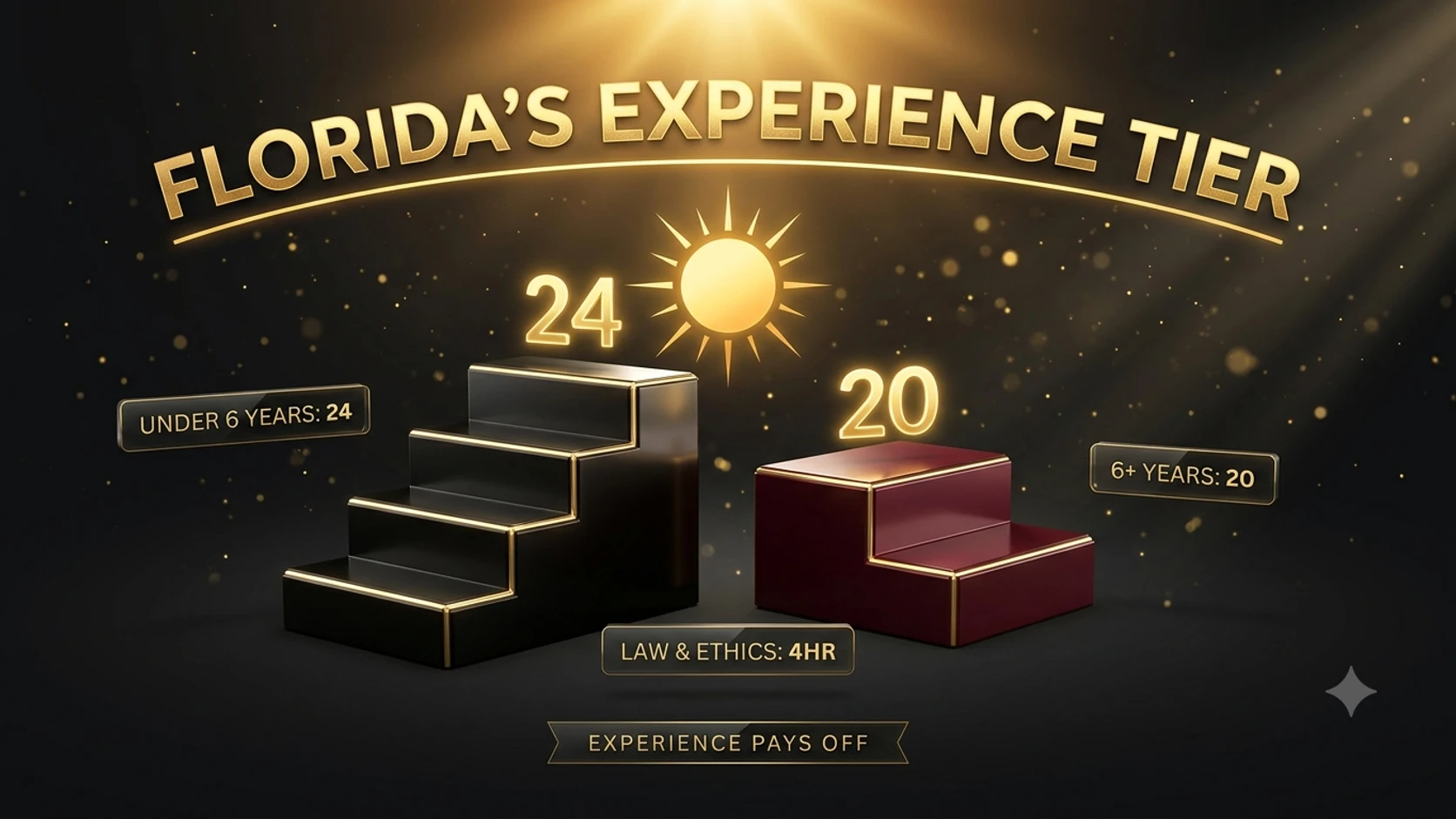
Florida's experience-tiered hour requirement is unusual
Most states apply the same CE hour total to every resident producer regardless of how long they've held the license. Florida does something different: producers of life, health, and property & casualty lines who have been licensed less than 6 years need 24 hours of CE per two-year term, while producers licensed 6 years or more need only 20 hours for the same term.
This tiered structure means two Florida producers holding identical lines of authority can have genuinely different hour totals due purely to how long each has been licensed — a detail that a generic state-by-state CE comparison chart often collapses into one number.
The 4-hour Law and Ethics course is fixed regardless of tier
Whether a producer owes 24 hours or 20 hours in total, all Florida agents are required to complete a 4-hour Law and Ethics course during every renewal period — this specific course requirement does not shrink or disappear at the six-year experience mark the way the general hour total does.
Because this is a fixed, specifically-numbered course (not just 'some ethics hours' pulled from a general catalog), confirm through the Florida Department of Financial Services CE system that the specific course you select is currently approved as satisfying this exact Law and Ethics requirement.
'Perpetual license, non-perpetual CE deadline' is the trap
Florida agent and adjuster licenses are technically perpetual — there is no license expiration date the way most states structure renewal. But this does not mean continuing education is optional or informal: the CE deadline, tied to the producer's birth month, still triggers real regulatory consequences including penalties or effective loss of active licensure status if missed.
The 'perpetual license' framing can create a false sense that nothing bad happens on a missed deadline. Treat the birth-month CE deadline with the same seriousness as a hard expiration date in another state, because functionally, the consequences of ignoring it are similar.
Worked example: crossing the six-year threshold mid-career
A health-insurance producer licensed in Florida for five years still owes the full 24-hour requirement (including the fixed 4-hour Law and Ethics course) for her current renewal cycle. Two years later, now past the six-year mark, her next renewal cycle only requires 20 hours total — but the same 4-hour Law and Ethics course still applies unchanged.
She notes the six-year anniversary of her original license date on her compliance calendar specifically because it changes her hour math going forward, even though nothing about her actual license or lines of authority changed.
How the 6-year experience threshold is actually calculated
Florida's reduced 20-hour requirement for producers with 6 or more years of licensed experience is calculated from the producer's continuous licensure history in Florida specifically, not from total industry experience across multiple states. A producer who spent 10 years licensed in another state before recently becoming licensed in Florida does not automatically qualify for the reduced tier — the clock generally starts from Florida licensure specifically.
The mandatory 4-hour Law and Ethics update course applies regardless of which experience tier a producer falls into — both the 24-hour newer-producer tier and the 20-hour experienced-producer tier include this same fixed 4-hour component, meaning the experience discount applies only to the general/elective portion of the requirement, not to the ethics-adjacent Law and Ethics update.
Florida producers should also be aware that the Department of Financial Services' CE course search tool allows filtering specifically for Law and Ethics-approved courses, which is worth using directly rather than assuming any course with 'ethics' in its title necessarily satisfies Florida's specific Law and Ethics update requirement, since Florida's version of this requirement is updated periodically to reflect current state statute changes.
What happens to the experience tier if a Florida license lapses and is reinstated
A producer whose Florida license lapses and is later reinstated should confirm directly with the Department of Financial Services whether the lapse affected their continuous-licensure count for purposes of the 6-year experience tier, since a lapse and reinstatement could, depending on how it's handled, interrupt what would otherwise have been continuous years of licensure.
This matters most for a producer sitting close to the 6-year threshold: a lapse shortly before reaching that mark could delay eligibility for the reduced 20-hour tier by more than just the length of the lapse itself, if the state's continuous-licensure calculation resets rather than simply pausing. Confirming this directly avoids an unpleasant surprise at the next renewal.
The bottom line
Florida's experience-tiered structure rewards continuous Florida licensure specifically, and the fixed 4-hour Law and Ethics update applies regardless of tier. Producers should confirm their specific tier and their Law and Ethics course's current approval status directly with the Department of Financial Services rather than assuming either detail based on general industry experience or an older course they completed some years back.
Primary and official sources used for this guide
Florida Department of Financial Services — Continuing EducationPrimary/official source for Florida's experience-tiered CE hour requirement and the Law and Ethics course.↗Source pages can change. Check the current text and effective date before relying on a threshold, waiting period, or required form.